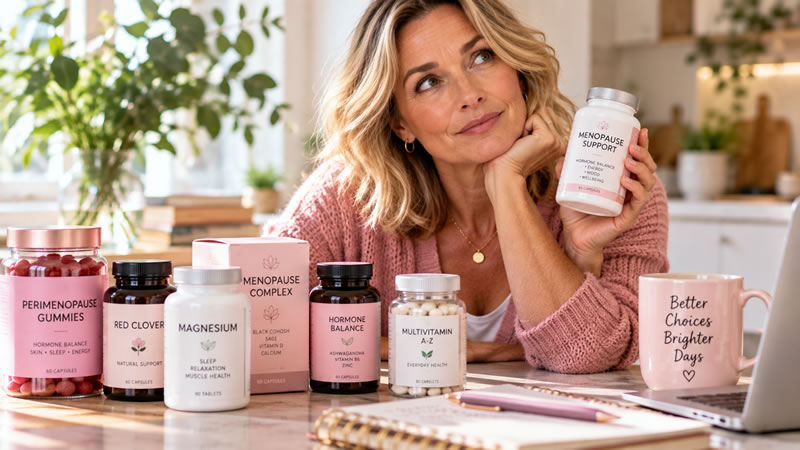
Walk into a pharmacy — or, more likely, scroll Instagram for five minutes — and you'd be forgiven for thinking menopause requires its own medicine cabinet.
- Menopause multivitamins.
- Perimenopause gummies.
- Hormone-balance blends.
- Sleep capsules.
- Brain-fog supplements.
- Hot-flush remedies.
And plenty of them aren't cheap.
When you're exhausted, forgetting words, waking up at 3am and wondering what on earth has happened to your body, a bottle promising to help with menopause support can sound extremely tempting.
But a new investigation from consumer group Which? has asked a very good question:
Are we actually paying for something better — or are we sometimes just paying extra because the word "menopause" is on the bottle?
Unfortunately, the results aren't brilliant.
What did Which? actually investigate?
Which? nutrition experts analysed 26 popular supplements marketed towards women experiencing perimenopause or menopause, or generally towards women over 45.
They looked at more than 80 different active ingredients, including vitamins, minerals and botanical extracts, and compared them with the scientific evidence behind their use.
Their conclusion?
Not one of the 26 products met the criteria to be named a Which? Best Buy. Which?
And some of the products weren't just a little more expensive than an ordinary multivitamin.
Which? found menopause supplements costing from 22p to £1.33 per daily dose — meaning the most expensive could cost almost £500 a year.
By comparison, one of its Great Value multivitamins costs around 6p a day — £21.90 a year. Which?
That's quite a menopause markup.
The problem isn't necessarily what's in them
This is an important distinction.
Which? isn't saying that every vitamin and mineral inside a menopause supplement is useless.
The problem is often how much is actually there.
A bottle might proudly list: Magnesium! Vitamin D! Calcium! Red clover! Black cohosh!
Fantastic.
But turn it over and look at the quantities and things can become rather less impressive.
Which? found examples where nutrients were present in amounts far below those considered useful or below the amounts used in studies.
This practice is sometimes referred to as "fairy-dusting" — putting enough of an impressive-sounding ingredient into a product to put it on the label, but potentially not enough to do very much. The Independent
And that's something worth remembering whenever you're comparing supplements:
An ingredient being in a product isn't the same as there being a useful amount of it.
What about calcium and vitamin D?
This was one of the most striking findings.
Bone health becomes increasingly important around and after menopause because falling oestrogen levels accelerate bone loss. Calcium and vitamin D therefore have genuine nutritional relevance at this stage of life.
Yet Which? found 20 of the 26 menopause supplements contained no calcium at all.
Six didn't contain vitamin D. And some of those that did contain these nutrients included surprisingly small quantities.
One product contained just 60mg of calcium, while another provided only 1.5 micrograms of vitamin D.
The NHS recommends that adults consider taking 10 micrograms of vitamin D daily during autumn and winter. Which?
Suddenly the enormous list of exotic ingredients on the front of the packet looks rather less important than reading the boring little numbers on the back.
So is a cheap multivitamin actually better?
Sometimes, potentially yes.
Which? highlighted Asda A-Z Multivitamins & Minerals, costing around 6p per day at the time of its investigation.
It contained all the essential vitamins, plus 200mg calcium and 100mg magnesium, and costs approximately £22 for a year's supply. The Independent
That's not to say everyone going through menopause needs to rush to Asda and buy one.
And it certainly doesn't mean taking a multivitamin will treat your menopause symptoms.
The more useful point is this:
Don't assume something labelled "menopause" is nutritionally superior to an ordinary supplement.
Compare what's actually inside it.
What about magnesium?
This is where things get particularly interesting because magnesium has become the midlife supplement.
Sleep? - Magnesium.
Stress? - Magnesium.
Muscle aches? - Magnesium.
Someone on Instagram will probably recommend magnesium.
It is an essential mineral and your body genuinely needs it.
But that doesn't automatically mean you need a supplement — or that the sprinkling of magnesium in a menopause blend is enough to achieve whatever benefit you're hoping for.
Which? highlighted one menopause product containing just 56mg of magnesium, around 15% of daily needs. Which?
So again: Read the dose, not just the ingredient list.
And what about all the herbs?
This is where menopause supplements become especially complicated.
Common ingredients include:
- black cohosh
- red clover/isoflavones
- sage
- ashwagandha
- St John's wort.
There is some evidence suggesting certain botanical ingredients may help some menopause symptoms.
But it's mixed. For example, Which? notes that some studies have suggested black cohosh may help hot flushes and night sweats, while a Cochrane review concluded the evidence wasn't sufficient to establish a benefit. Which?
There's another problem. Even where research has used a particular botanical at a certain dose, a menopause blend might contain substantially less.
Which? found this happening repeatedly.
So seeing "contains black cohosh" on the box doesn't tell you whether you're getting anything close to the amount studied in clinical trials.
“But it's natural” doesn't automatically mean harmless
This deserves its own section. Herbal supplements are often perceived as the gentler alternative to medication.
But natural does not mean risk-free.
Herbal remedies can cause side effects and interact with medicines.
St John's wort is a particularly good example because it can interact with numerous medications.
Which? also points to rare reports of liver injury associated with supplements including black cohosh and ashwagandha. Which?
So if you're taking medication — including HRT — don't assume you can add several herbal products without mentioning them to your pharmacist or doctor.
What about menopause gummies?
Sorry, gummy fans. They didn't escape either.
Which?'s principal researcher and public health nutritionist Shefalee Loth was particularly unimpressed with this format.
Making something into a pleasant-tasting gummy requires room for ingredients such as sugars or sweeteners and gelling agents.
That leaves less physical space for useful quantities of active ingredients, and you may need several gummies to provide an adequate dose. Which?
- They're convenient.
- They're pretty.
- They taste considerably nicer than a giant tablet.
But none of those things tells us whether they work.
Does this mean menopause supplements are a waste of money?
Not necessarily. And this is where we don't want to swing too far in the opposite direction.
Some people may have a genuine nutritional deficiency or increased requirement for a particular nutrient.
Vitamin D is an obvious example.
Iron may be relevant for someone experiencing heavy periods during perimenopause — but taking iron when you don't need it isn't a good idea either.
Calcium intake matters for bone health.
And there is research into individual botanical ingredients for specific menopause symptoms.
The issue highlighted by the Which? investigation is the assumption that buying an expensive all-in-one menopause formulation automatically gives you what you need.
It may not.
Sometimes a standard multivitamin could provide more useful quantities of everyday nutrients for substantially less money.
Sometimes you may be better off with one specific supplement.
And sometimes you may not need a supplement at all.
Before buying a menopause supplement, turn the bottle around
The front of the packet is marketing.
The useful information is usually on the back.
Before spending £20, £30 or £40, ask:
What am I actually taking this for?
"Menopause" isn't a symptom.
Are you trying to address a diagnosed vitamin D deficiency? Support bone health? Correct low iron? Improve hot flushes? Sleep better?
Those are very different things.
Then look at how much of each ingredient you're actually getting, rather than how many impressive ingredients are listed.
And ask yourself:
Could I get what I need from my diet or a much cheaper individual supplement instead?
If you're unsure, a pharmacist, GP or registered dietitian can help — particularly if you take medication or have an existing health condition.
What actually helps menopause symptoms?
This is perhaps the most important point.
A supplement isn't automatically a menopause treatment just because somebody has written "menopause" on the label.
If symptoms such as hot flushes, night sweats, vaginal dryness, low mood or sleep disturbance are affecting your quality of life, there are evidence-based treatments available.
That may include HRT, where appropriate, as well as non-hormonal treatments and symptom-specific options.
Diet, physical activity, adequate protein, fibre, sleep and maintaining bone and muscle strength also become particularly important during midlife.
Supplements can potentially sit alongside those things.
They shouldn't automatically replace them.
The Hot Again take
We're actually delighted that menopause is finally being talked about.
For generations women were expected to quietly get on with it.
Now there are products specifically designed for us.
Great.
But there's a downside to becoming a recognised consumer group:
everyone suddenly wants to sell us something.
Put MENOPAUSE on a bottle. Add some pink packaging. Sprinkle in a few fashionable ingredients. Charge £30.
And when you're tired, anxious and desperate to feel like yourself again, it's incredibly easy to think:
Maybe this is the thing I'm missing.
Sometimes a supplement may genuinely be useful.
But the Which? investigation is a very good reminder that price, packaging and the word "menopause" tell you remarkably little about what's actually inside the bottle.
So don't shop by the front label. Turn it around. Look at the ingredients. Look at the doses.
Think about what you're actually trying to achieve.
And perhaps most importantly, don't feel that navigating menopause requires a shelf full of expensive supplements.
Because sometimes the menopause product costing £30 isn't necessarily doing anything that the boring £2 multivitamin beside it couldn't do.
And sometimes you don't need either.
It's not just you — they're marketing to all of us.
Source: The Guardian: Menopause supplements costing more than £400 a year 'no better than cheap multivitamin