
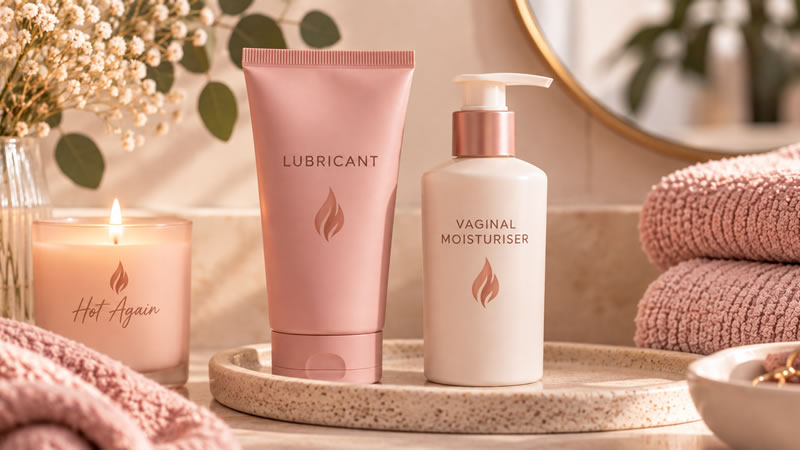
Lubricant vs Vaginal Moisturiser: What’s the Difference?
They both help with dryness. They both come in tubes and bottles. And they're often sitting next to each other on the shelf. But lubricant and vaginal moisturiser do two quite different jobs. Here's how to know which one you might need.
If nobody has ever explained the difference between lubricant and vaginal moisturiser to you, you're in good company.
For years, many of us have thought of lubricant as something you might use occasionally to make sex a bit more comfortable – and probably haven't thought about vaginal moisturiser at all.
Then menopause arrives and suddenly you're faced with an entire category of products promising hydration, comfort and relief.
Lubricant. Vaginal moisturiser. Vaginal gel. Intimate moisturiser.
What are we actually supposed to be buying?
The easiest way to remember it is this:
Lubricant is mainly for the moment.
Vaginal moisturiser is for ongoing dryness.
And yes – you can use both.
What does lubricant do?
Lubricant – or lube – reduces friction.
It's most commonly used during sex, masturbation or when using a sex toy, particularly when there isn't enough natural lubrication to make things comfortable.
And during perimenopause and menopause, that can become much more important.
Changes in oestrogen can mean that the vagina produces less natural lubrication during arousal. You can be completely turned on mentally and still find that your body isn't producing the lubrication it once did.
That does not mean you're not attracted to your partner.
It doesn't mean you're "not aroused enough".
And it definitely doesn't mean you've failed some sort of sex test.
Sometimes your body simply needs a little assistance.
Think of lubricant as...
Something that makes things glide more easily when you need it.
You apply it before or during sexual activity and add more if necessary.
It can help make penetration more comfortable and reduce the friction that can cause soreness or irritation.
But lubricant doesn't generally treat ongoing vaginal dryness.
That's where vaginal moisturiser comes in.
So what is a vaginal moisturiser?
A vaginal moisturiser is designed to provide longer-lasting relief from vaginal dryness.
Rather than only being used when you're having sex, vaginal moisturisers are usually applied regularly – according to the individual product instructions – whether you're sexually active or not.
They're designed to help keep vaginal tissues hydrated and comfortable over time.
Think of vaginal moisturiser as...
The clue really is in the name.
You wouldn't only moisturise dry skin immediately before somebody touched it.
You'd use moisturiser regularly to help keep the skin hydrated.
A vaginal moisturiser works on a similar principle, although obviously you should only use products specifically designed for vaginal use.
How do I know which one I need?
A useful question is:
When does the dryness bother you?
If you're comfortable normally but experience dryness or friction during sex, a lubricant may be all you need.
If you're experiencing dryness, irritation or discomfort during everyday life as well, a vaginal moisturiser may be more appropriate.
And if you experience both?
You may benefit from using a vaginal moisturiser regularly and lubricant during sex.
They aren't competing products.
They do different jobs.
Why does vaginal dryness happen during menopause?
Here comes oestrogen again.
Oestrogen helps maintain the thickness, elasticity and natural moisture of vaginal and vulval tissues.
As oestrogen levels decline during perimenopause and menopause, those tissues can become thinner, drier and more fragile.
You might notice:
- vaginal dryness
- itching or irritation
- burning or soreness
- discomfort during sex
- less natural lubrication when you're aroused
- a feeling of tightness
- soreness after sex
- urinary symptoms or recurrent UTIs
These symptoms can be part of Genitourinary Syndrome of Menopause (GSM).
And unlike some menopause symptoms, vaginal and urinary symptoms don't necessarily disappear once you've made it through menopause.
So they're worth treating rather than waiting for them to go away.
Let's talk about the different types of lubricant
This is where buying lube can get surprisingly complicated.
There are three main types you'll commonly come across.
Water-based lubricant
This is probably the easiest place to start.
Water-based lubricants are widely available, easy to wash off and generally compatible with condoms and most sex toys.
The downside?
Some can dry out relatively quickly, meaning you may need to reapply them.
And formulations vary enormously.
If one makes you feel sticky, irritated or uncomfortable, don't assume you simply "don't get on with lube". Another formulation may suit you much better.
Silicone-based lubricant
Silicone lubricants tend to stay slippery for longer than water-based ones, which can be particularly helpful when vaginal dryness is significant.
You generally need less of them and don't have to reapply as frequently.
They're also waterproof, which can be useful for shower or bath sex.
However, check compatibility before using silicone lubricant with silicone sex toys, as some combinations can damage the toy's surface.
Oil-based lubricant
Oil-based lubricants can feel rich and long-lasting, but there's an important catch.
Oil can damage latex condoms, potentially making them less effective.
So if you're using latex condoms, choose a lubricant specifically labelled as compatible with them.
And remember: pregnancy isn't the only reason condoms matter. Sexually transmitted infections haven't received the memo that we've reached menopause.
Do ingredients matter?
They can.
The vagina and vulva are sensitive areas, and something being labelled "natural" or "intimate" doesn't automatically make it suitable for everyone.
If you're prone to irritation, you may prefer products without unnecessary fragrance, flavours or warming/tingling ingredients.
A product designed to smell like strawberries and create a mysterious "warming sensation" may sound entertaining.
Your menopausal vulva may have other ideas.
If something stings, burns or causes irritation, stop using it.
Pleasure products shouldn't require bravery.
What about pH?
You may see vaginal products advertising that they're pH balanced.
That's relevant because the vagina naturally maintains an acidic environment, and menopause-related hormonal changes can alter vaginal pH.
Products intended for internal vaginal use should therefore be specifically formulated for that purpose.
This is another reason not to improvise with ordinary body lotion, moisturiser or whatever happens to be sitting beside the bed.
Your face cream is staying on your face.
Can I just use coconut oil?
This one comes up a lot.
Some people do use coconut oil as a lubricant and like the way it feels.
However, oils can damage latex condoms, and products that weren't specifically formulated for vaginal use may not suit everyone.
If you're experiencing menopause-related dryness or irritation, I'd favour products that have actually been designed and tested for intimate use rather than raiding the kitchen cupboard.
Coconut oil belongs beautifully in a Thai curry.
It doesn't have to have a second career.
Do I need vaginal oestrogen instead?
Possibly.
Lubricants and moisturisers can be extremely useful for managing symptoms, but if vaginal dryness, soreness or painful sex is persistent, it's worth speaking to your GP or another healthcare professional about vaginal oestrogen.
Vaginal oestrogen treats the underlying menopause-related changes in the vaginal tissues rather than simply adding moisture or reducing friction.
It's a low-dose local treatment and can be used by many women, including some who aren't using systemic HRT.
And importantly, you can sometimes use vaginal oestrogen alongside HRT if systemic HRT isn't adequately controlling vaginal symptoms.
Your doctor or another qualified healthcare professional can advise whether it's suitable for you.
A simple way to remember the difference
Here's the Hot Again cheat sheet:
| Lubricant | Vaginal moisturiser | |
|---|---|---|
| Main purpose | Reduces friction | Helps manage ongoing dryness |
| When used | Usually during sex or sexual activity | Regularly |
| How long it works | Short term | Longer lasting |
| Helps painful sex? | Can help when friction/dryness is the cause | Can help improve underlying dryness |
| Can I use both? | Yes | Yes |
What should I buy?
This is one area where "whatever's cheapest" isn't necessarily the best strategy.
Look for a product that's actually designed for the job you need it to do.
For lubricant, consider:
- whether it's water, silicone or oil based
- condom compatibility
- sex-toy compatibility
- how long-lasting it is
- whether it contains fragrance or other potential irritants
- whether it's designed for sensitive intimate tissues
For vaginal moisturisers, check:
- that it's specifically intended for vaginal use
- how frequently it needs to be applied
- whether it's used internally, externally or both
- its ingredients
- the manufacturer's instructions
And don't be afraid to try something different if the first product doesn't suit you.
We're all annoyingly individual.
There's nothing embarrassing about needing either
Perhaps the biggest misconception about lubricant is that needing it somehow means your body isn't working properly.
It doesn't.
Natural lubrication varies throughout life.
Hormones change.
Bodies change.
Medication can affect lubrication.
Stress can affect arousal.
And menopause can absolutely change how quickly – and how much – your body lubricates.
Using lube isn't admitting defeat.
It's making sex more comfortable.
Which seems like a fairly sensible upgrade.
Hot Again says...
If it hurts, adding more friction isn't going to improve matters.
Keep a good lubricant somewhere you can actually reach it.
Not hidden at the back of the bathroom cabinet behind the spare toothpaste where using it requires an expedition.
And if dryness is bothering you outside the bedroom too, don't just keep reaching for more lube.
Consider a vaginal moisturiser – and talk to your GP about whether treatments such as vaginal oestrogen could help.
Your vagina doesn't have to spend the next few decades feeling like the Sahara.
When should I get medical advice?
Vaginal dryness is extremely common around menopause, but don't automatically assume every vaginal symptom is hormonal.
Speak to a healthcare professional if symptoms are persistent, severe or unexplained, or if you experience:
- bleeding after sex
- bleeding after menopause
- unusual discharge
- sores or changes to the vulval skin
- significant or worsening pain
- recurrent urinary infections
And if a product you've started using causes burning, swelling, pain or significant irritation, stop using it and seek advice if symptoms don't settle.
The bottom line?
Lubricant makes sex more comfortable in the moment. Vaginal moisturiser helps manage dryness between those moments.
You don't have to choose one team.
Sometimes your body needs one.
Sometimes it needs both.
And sometimes persistent symptoms need a little more help than either can provide.
This article is for general information and isn't a substitute for individual medical advice. If you're experiencing persistent vaginal dryness, pain or other changes in your vaginal or vulval health, speak to a qualified healthcare professional.