
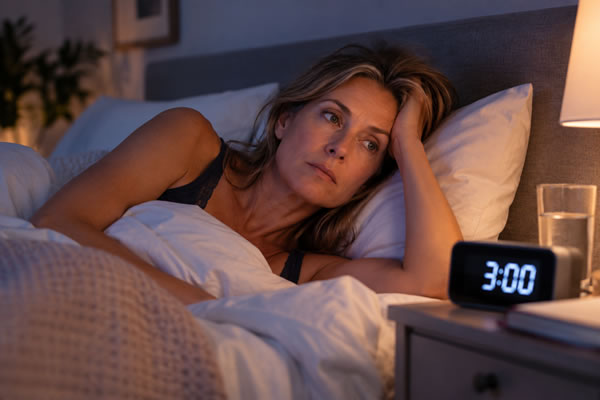
You went to bed exhausted. You fell asleep without too much trouble.
Then suddenly, you're awake.
You reach for your phone.
3:07am.
Again.
And now your brain has apparently decided this is the perfect time to remember an email you forgot to send in 2019, wonder whether you've paid the car insurance and reconsider every major life decision you've ever made.
If this has started happening since you've entered your 40s or perimenopause, you're definitely not imagining it. Sleep problems are extremely common during the menopause transition — the British Menopause Society estimates they affect around 40–56% of women.
So why does perimenopause seem to come with its own unwanted 3am alarm clock?
And, more importantly, what can you actually do about it?
Why does perimenopause mess with sleep?
As with so many things in perimenopause, there isn't necessarily one single culprit.
Your hormones are changing, but sleep can also be disrupted by night sweats, anxiety, stress, bladder changes and changes to your normal sleep patterns.
The NHS recognises difficulty getting to sleep and staying asleep as a common symptom of perimenopause and menopause.
And sometimes the problem isn't falling asleep at all.
You can be absolutely shattered at 10pm, sleep beautifully for four or five hours and then...
PING.
Wide awake.
Hormones may be playing a part
During perimenopause, levels of oestrogen and progesterone change and fluctuate.
At the same time, you may develop other menopause symptoms that disturb sleep — particularly hot flushes and night sweats.
You don't necessarily have to wake up absolutely drenched either.
You might simply become too warm, throw the duvet off, cool down, pull it back on...
...and realise you're now completely awake.
The NHS specifically notes that menopausal sleep problems can be worse when you're experiencing night sweats.
Then there's the 3am brain
This is perhaps the cruellest part.
You wake up briefly — which might not have been a problem previously — and your brain immediately joins the party.
Suddenly you're thinking.
Work.
Money.
Children.
Parents.
Relationships.
That weird thing you said at a party six years ago.
Whether the dog needs a vet appointment.
Whether you should change career.
Whether that pain in your shoulder is something sinister.
And once your brain has moved into problem-solving mode, getting back to sleep becomes considerably harder.
Mood changes and anxiety can occur during perimenopause too, while poor sleep itself can make you feel more stressed, anxious and irritable the following day.
It's a particularly unhelpful little circle.
Is 3am itself significant?
Probably not in the way social media might have you believe.
You'll find plenty of claims online about waking at particular times being caused by cortisol spikes, liver problems, blood sugar crashes or various organs "detoxifying".
Be wary of very precise explanations like these.
There's nothing magical about 3am.
If you go to bed somewhere around 10–11pm, the early hours simply occur several hours into your night's sleep, when your sleep architecture is different from the beginning of the night and brief awakenings can become easier to notice.
The more useful question isn't:
"Why exactly 3am?"
It's:
"What's waking me up — and why can't I get back to sleep?"
So what actually helps?
Unfortunately, I'm not going to tell you that one magnesium gummy and a lavender pillow spray will guarantee eight uninterrupted hours.
If only.
But there are things worth trying.
1. Deal with the night sweats
If you're waking hot, sweaty or constantly kicking the duvet off, tackling that may improve your sleep too.
Keep the bedroom cool, consider lighter bedding and nightwear, and notice whether things such as alcohol, caffeine, spicy food or hot drinks seem to make your symptoms worse.
The NHS recommends measures including lightweight clothing, keeping the bedroom cool and reducing individual triggers for hot flushes and night sweats.
And if night sweats are regularly destroying your sleep, it's worth talking to your GP about menopause treatment rather than simply buying increasingly powerful fans.
2. Look at your caffeine habit
That innocent 4pm coffee may be worth experimenting with.
Caffeine stays in the body for several hours, and people vary enormously in how sensitive they are to it.
Try moving your last coffee or caffeinated tea earlier for a couple of weeks and see whether anything changes.
You don't necessarily have to give up your beloved morning coffee.
We're trying to improve your quality of life here, not remove all remaining joy from it.
3. Watch the evening wine
Alcohol can make you feel sleepy initially, which is why it's easy to assume it helps with sleep.
But your night's sleep may be more disrupted afterwards.
It's also a potential trigger for hot flushes and night sweats for some women. The NHS therefore suggests reducing alcohol if it seems to affect your menopause symptoms.
If you've got into the habit of having a glass of wine most evenings, try a couple of weeks without it and see what happens to your 3am wake-ups.
Consider it an experiment rather than a life sentence.
4. Stop checking the time
This is surprisingly powerful.
You wake up.
You look at the clock.
2:47am.
Then again.
3:18am.
Then:
"If I fall asleep RIGHT NOW I'll still get three hours and 42 minutes."
Congratulations. You've turned sleeping into a maths exam.
If possible, turn the clock away and don't keep checking your phone.
Knowing exactly how badly you're sleeping rarely helps you sleep better.
5. Don't spend hours fighting with your pillow
There comes a point where lying in bed thinking I MUST GO TO SLEEP becomes counterproductive.
If you've been awake for a while and feel increasingly frustrated, get out of bed for a little while.
Keep the lights low and do something quiet and unstimulating.
Read a few pages of a book. Listen to something relaxing.
Then return to bed when you feel sleepy again.
What you're trying to avoid is teaching your brain that bed = the place where we lie awake worrying for three hours.
6. Give your brain somewhere else to put things
If your 3am brain likes presenting you with tomorrow's entire to-do list, try emptying some of it before bed.
Keep a notebook nearby or spend five minutes in the evening writing down anything you're worried you'll forget.
You're essentially telling your brain:
It's written down. We can deal with it tomorrow.
Whether your brain listens is another matter.
But it's worth a try.
7. Keep your sleep routine boringly consistent
Our bodies generally appreciate routine more than we'd like to admit.
Try to keep roughly consistent sleep and waking times, particularly your morning wake-up time.
Regular exercise and daylight exposure during the day can also support healthy sleep.
This isn't very exciting advice.
But unfortunately, "consistent sleep schedule and regular exercise" has rather more evidence behind it than "£38 moon-charged menopause sleep mist".
8. What about magnesium?
Magnesium has become almost synonymous with menopause sleep on social media.
It's an essential mineral involved in many processes in the body, and some women like taking a magnesium supplement in the evening.
But it's worth keeping expectations realistic.
A supplement isn't necessarily going to solve persistent insomnia — particularly if the thing waking you is untreated night sweats, anxiety, sleep apnoea or another underlying issue.
If you're considering supplements, check that they're appropriate alongside any medicines you take and speak to a pharmacist or healthcare professional if you're unsure.
Hot Again rule: supplements can be part of the toolkit. They're not magic.
9. Don't dismiss CBT because "I'm not depressed"
This one might surprise you.
Cognitive behavioural therapy isn't only used for depression or anxiety.
There are specific CBT approaches for insomnia and menopause-related sleep difficulties.
In fact, current NICE menopause guidance specifically recommends considering menopause-specific CBT for sleep problems such as night-time awakening associated with vasomotor symptoms. It can be used alongside treatments such as HRT or as an option for people who don't want or can't use them.
So if your sleep problems have become established, it's a genuine treatment option rather than somebody simply telling you to "relax more".
10. Could HRT help?
Possibly — particularly if hot flushes and night sweats are what's disturbing your sleep.
NICE recommends offering HRT for menopausal vasomotor symptoms such as hot flushes and sweats.
That doesn't mean HRT is a sleeping tablet, and it isn't suitable or wanted by everybody.
But if you've developed sleep problems alongside other perimenopause symptoms, it's worth discussing the whole picture with your GP or menopause clinician rather than treating every symptom as an unrelated problem.
When should I talk to my GP?
Occasional rubbish nights are part of being human.
But if you're regularly waking during the night and it's affecting your mood, concentration, work or ability to function during the day, ask for help.
It's particularly worth speaking to a healthcare professional if you snore heavily, wake gasping or choking, experience uncomfortable or restless legs, are struggling significantly with anxiety or low mood, or your sleep suddenly changes without an obvious reason.
Not every sleep problem in a woman in her 40s or 50s is automatically menopause.
Sometimes another cause needs investigating.
And finally...
There's something particularly miserable about being exhausted and unable to sleep.
You're tired all day.
You promise yourself you'll have an early night.
You crawl gratefully into bed.
And then at 3am your brain decides it would like to discuss the family finances.
Again.
If this started during perimenopause, you're far from alone. Sleep disturbance is one of the most common problems women report during the menopause transition.
Start by looking at what's actually waking you — heat, stress, needing the loo, discomfort, or seemingly nothing at all.
Experiment with the simple things.
And if you're still struggling, don't accept years of terrible sleep as something you simply have to put up with because you're in midlife.
You deserve better than surviving on caffeine and rage.
Hot Again — because feeling like yourself again starts with actually getting some sleep.
This article provides general information and isn't a substitute for individual medical advice. If you're experiencing persistent sleep problems or symptoms that concern you, speak to your GP or another qualified healthcare professional.