
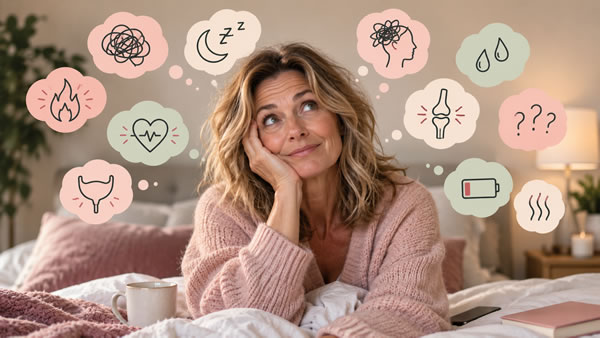
Hot flushes? We’d heard about those.
Periods going a bit haywire? Fine. Expected.
But itchy skin? Burning mouth? Heart palpitations? Suddenly forgetting the name of someone you’ve known for ten years?
Nobody mentioned any of that.
For many women, perimenopause doesn't arrive with a polite announcement and a textbook list of symptoms. Instead, you can spend months wondering why your body has apparently decided to start doing completely random things.
And because some of these symptoms seem totally unrelated to periods or hormones, menopause might not even cross your mind.
So, if you've recently found yourself Googling "Why is my tongue burning?" at 2am, this one's for you.
First: what actually is perimenopause?
Perimenopause is the transition leading up to menopause, when levels of hormones including oestrogen and progesterone begin to fluctuate.
It can start years before your periods stop completely.
For some women, changes are relatively mild. For others, it feels as though someone has pressed SHUFFLE on their entire body.
Hormone receptors exist throughout the body, which helps explain why changes aren't necessarily limited to periods and hot flushes.
Here are some of the stranger things women can experience.
1. Itchy skin
You haven't changed your washing powder.
There's no obvious rash.
Yet suddenly you're scratching your arms, legs, back or scalp like you've rolled through a field of nettles.
Declining oestrogen can affect the skin's ability to retain moisture and can contribute to dryness and sensitivity.
Your previously perfectly adequate body lotion may suddenly seem completely useless.
Rich, fragrance-free moisturisers and gentler skincare can help. But persistent or severe itching — particularly with a rash or other symptoms — is worth discussing with a healthcare professional rather than automatically blaming hormones.
2. Heart palpitations
You're sitting watching television when suddenly...
THUMP. THUMP. Flutter.
Your heart appears to have remembered an urgent appointment.
Palpitations — feeling your heart racing, pounding, fluttering or skipping beats — can occur around perimenopause and menopause.
They can feel particularly alarming if you've never experienced them before.
But don't assume new palpitations are just hormones. Heart rhythm changes can have many causes.
If they're new, frequent, worsening or accompanied by chest pain, breathlessness, fainting or severe dizziness, seek medical advice promptly.
3. Burning mouth or a strange-feeling tongue
Yes. Apparently this is a thing.
Some women experience burning, tingling, tenderness or altered sensations affecting the tongue, lips, gums or other areas of the mouth.
You might also notice a dry mouth or changes in taste.
Hormonal changes may be one factor, but nutritional deficiencies, medications, oral conditions and other health issues can cause similar symptoms.
So this is another one worth mentioning to your GP or dentist if it persists.
4. Electric-shock sensations
This has to be one of the stranger ones.
Some women describe brief sensations that feel like tiny electric shocks, zaps or jolts under the skin.
They're often fleeting, but understandably rather unnerving when you don't know what's causing them.
Hormonal fluctuations may affect the nervous system, although unusual, persistent or worsening neurological sensations should always be properly assessed rather than self-diagnosed as menopause.
5. Tingling hands and feet
Pins and needles aren't necessarily caused by sleeping on your arm.
Some women report tingling, prickling, numbness or crawling sensations during perimenopause.
Again, hormones may play a role, but there are lots of other possible causes of persistent numbness or tingling.
If it's happening regularly, affecting one side of your body, associated with weakness or otherwise concerning you, speak to your GP.
6. Aching joints
Yesterday you were 42.
Today you appear to be 97 when getting off the sofa.
Knees ache.
Hips complain.
Your shoulders have developed opinions.
Joint and muscle aches are commonly reported around menopause. Changes in oestrogen may influence inflammation, muscles, tendons and joints.
Movement can often help — even when the sofa is making an extremely persuasive counterargument.
Strength training is particularly useful as we get older because maintaining muscle and bone strength becomes increasingly important.
But persistent swelling, severe pain or significant changes in a joint deserve medical assessment.
7. Feeling dizzy or slightly "off"
Not necessarily room-spinning dizziness.
Sometimes it's more of a strange light-headed, unsteady or floaty feeling.
Changes in hormones, sleep, stress and migraine patterns may all potentially contribute.
However, dizziness has many possible causes — from dehydration and low blood pressure to inner-ear problems and medication — so don't automatically put persistent dizziness down to perimenopause.
8. Headaches suddenly changing
Perhaps you've always had occasional headaches.
Then perimenopause arrives and apparently decides they need a complete rebrand.
Hormonal fluctuations can affect migraine and headache patterns. Some women experience migraines for the first time; others find existing migraines improve or worsen.
Keeping a diary can be useful for spotting links between headaches, periods, sleep, food and other triggers.
A sudden severe headache or a major unexplained change in your usual headache pattern needs medical attention.
9. Dry eyes
Vaginal dryness gets most of the menopause publicity.
Turns out your eyes can join in too.
Hormonal changes can affect tear production and the surface of the eye, potentially leaving your eyes feeling gritty, sore, watery or strangely tired.
Yes — dry eyes can actually water more.
Lubricating eye drops may help, but persistent eye discomfort or changes to your vision should be assessed by an optometrist or doctor.
10. Gum and mouth changes
Suddenly your gums feel sensitive.
Your mouth feels dry.
Your teeth seem more sensitive.
Or your gums bleed more easily than they used to.
Hormonal changes can affect oral tissues, while dry mouth can also increase the risk of dental problems.
Don't skip your dental check-ups and don't assume bleeding or painful gums are simply menopause.
Your dentist would much rather you ask.
11. Changes in body odour
This is a particularly rude one.
You've used the same deodorant for approximately 17 years and suddenly...
Who smells?
Oh.
Apparently it's you.
Hormonal fluctuations, increased sweating and changes to the skin's bacteria can all affect body odour.
Night sweats and hot flushes obviously don't help matters.
It doesn't mean you've suddenly become unhygienic. You may simply need to rethink products, fabrics or how frequently you change clothes after sweating.
12. Suddenly needing to wee. NOW.
Not in ten minutes.
Not when you've finished putting the shopping away.
NOW.
Oestrogen changes can affect tissues around the vagina, bladder and urethra, and some women experience urinary urgency, increased frequency or recurrent urinary tract infections around menopause.
These symptoms form part of what's known as Genitourinary Syndrome of Menopause (GSM).
Don't quietly accept bladder problems as an inevitable consequence of getting older. There are treatments, including pelvic health physiotherapy and, where appropriate, local vaginal oestrogen.
13. Tinnitus
That ringing, buzzing or humming in your ears can be incredibly irritating — particularly when you're trying to sleep.
Some women report tinnitus appearing or changing around menopause, although the relationship between hormones and tinnitus isn't completely understood.
Because tinnitus has many potential causes, new or persistent symptoms should be checked, particularly if they're one-sided, pulsatile or accompanied by hearing loss or dizziness.
14. Feeling freezing cold
Menopause is all about being hot, right?
Not necessarily.
Temperature regulation can become rather unpredictable.
One minute you're throwing the duvet across the room because you're approximately the temperature of the sun.
Half an hour later you're retrieving it because you're freezing.
Hormonal changes can affect the body's temperature regulation, although persistent cold intolerance can also be associated with conditions such as thyroid problems or anaemia.
15. The disappearing word phenomenon
You're halfway through a sentence.
You know exactly what you want to say.
You can practically see the word.
But apparently your brain has put it somewhere safe.
"Can you pass me the... you know... the thing... THE THING WE USE FOR..."
Scissors.
You wanted scissors.
Word-finding difficulties, forgetfulness and problems concentrating are commonly described as menopause brain fog.
Poor sleep, stress and anxiety can pile on too.
It's frustrating — and occasionally hilarious — but you're certainly not the only person standing in the kitchen wondering why you walked into it.
16. Anxiety that seems to come from nowhere
Perhaps you've never considered yourself particularly anxious.
Then suddenly you're worrying about everything.
You wake with a strange sense of dread.
Small problems feel enormous.
Or your brain helpfully produces a catalogue of everything that could possibly go wrong at precisely 3am.
Mood changes and anxiety can occur during perimenopause, and fluctuating hormones may be part of the picture.
That doesn't mean you have to simply tolerate it.
If anxiety is affecting your everyday life, sleep or relationships, talk to your GP. Support might involve lifestyle changes, psychological therapies, HRT where appropriate, medication, or a combination.
17. Sleep completely falling apart
You go to bed tired.
You fall asleep.
Then...
3:07am.
Hello.
Sometimes there's a night sweat involved. Sometimes you need the loo. Sometimes absolutely nothing has happened and your brain has simply decided this is an excellent opportunity to reconsider every decision you've made since 1998.
Sleep disruption is extremely common during perimenopause.
And unfortunately, poor sleep then makes practically everything else feel worse — mood, anxiety, appetite, concentration, energy and our ability to tolerate other humans.
We'll be talking about this one a LOT on Hot Again.
So... is EVERYTHING perimenopause?
No.
And this is really important.
When you're at the right age and experiencing several classic symptoms, it can be tempting to put every new ache, pain or strange sensation into the menopause bucket.
But women in midlife can develop medical conditions completely unrelated to menopause.
New, severe, persistent or worrying symptoms deserve proper medical attention.
Your GP can help establish whether something is likely to be connected to hormonal changes or whether it needs investigating separately.
You're not imagining it
One of the hardest things about perimenopause can be how disconnected the symptoms seem.
A dodgy shoulder.
An itchy scalp.
Heart flutters.
Anxiety.
Three hours' sleep.
Dry eyes.
And now you can't remember what you walked upstairs for.
Individually, none of it necessarily screams HORMONES.
But once you start joining the dots, things can begin to make a little more sense.
Understanding what's happening doesn't magically make every symptom disappear.
But it can replace:
"What on earth is wrong with me?"
with:
"Ah. This might be perimenopause. Let's find out what I can do about it."
And that's a much better place to start.
Welcome to Hot Again. Midlife is weird. Let's talk about it.
This article provides general information only and isn't a substitute for medical advice, diagnosis or treatment. Symptoms associated with perimenopause can also have other causes. If you develop new, persistent, severe or worrying symptoms, speak to your GP or another qualified healthcare professional.