Are Menopause Supplements a Waste of Money? What’s Actually Worth Taking?
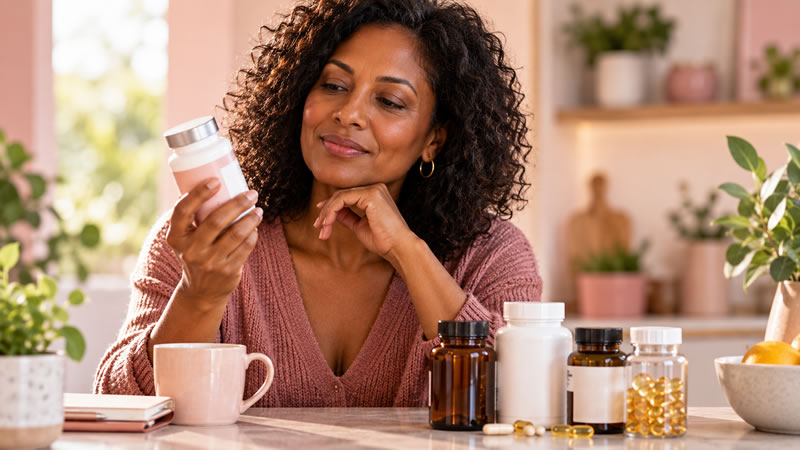
If your bathroom cupboard contains a collection of menopause supplements promising better sleep, balanced hormones, more energy, fewer hot flushes and a brain that can finally remember why it walked into the kitchen… you’re definitely not alone.
Menopause has become big business.
But new research has raised some uncomfortable questions about exactly what we’re paying for.
A study led by researchers at University College London (UCL) looked at 201 menopause supplements sold by nine major UK retailers and found a bewildering mixture of ingredients, formulations and prices.
Some cost as much as £95 a month.
And the researchers’ conclusion was essentially this: there simply isn’t strong scientific evidence that many of the ingredients being marketed to menopausal women actually improve menopause symptoms.
So should we throw every supplement in the bin?
Not necessarily.
But perhaps it’s time we became much more selective about what we're buying.
The menopause supplement gold rush
Professor Joyce Harper, Professor of Reproductive Science at UCL and senior author of the research, described what’s happening as a “menopause gold rush.”
It isn't difficult to see why.
Search online for help with menopause and you'll quickly find supplements promising to support everything from hormones and sleep to energy, mood, memory, bones, hair and libido.
The problem highlighted by the UCL research is that there was remarkably little consistency between the products being sold.
Around 80% contained herbs, 77% contained vitamins and 74% contained phytoestrogens, yet there wasn't one ingredient – or even one category of ingredient – that appeared consistently across the products.
That raises an obvious question.
If these products are all designed to tackle the same thing, why are the ingredients so completely different?
What about black cohosh, red clover and other menopause herbs?
This is where things get particularly interesting.
Some of the most familiar ingredients in menopause supplements include:
-
black cohosh
-
red clover
-
sage
-
vitamin B6
-
various phytoestrogens
-
herbal extracts
You may have seen claims that these ingredients can balance hormones or reduce hot flushes.
The reality is much less clear-cut.
NICE says there is some evidence that isoflavones or black cohosh may relieve hot flushes, but also warns that preparations vary, their safety is uncertain and interactions with other medicines have been reported.
The NHS similarly says there is very little evidence showing how well herbal remedies such as red clover and black cohosh work or how safe they are.
Natural doesn't automatically mean harmless either.
Some herbal products can interact with medicines, and black cohosh has been associated with rare cases of liver problems.
That's why we wouldn't recommend taking a cocktail of herbal menopause supplements simply because the label says “natural”.
So are there any supplements worth taking?
This is where the headlines become slightly misleading.
The research isn't saying that all supplements are pointless.
There's an important difference between taking a supplement because your body needs a particular nutrient and buying an expensive product claiming to “balance your menopause hormones”.
Vitamin D
This is probably the simplest place to start.
Vitamin D helps maintain healthy bones, muscles and teeth, and bone health becomes particularly important around menopause because falling oestrogen levels accelerate bone loss.
The NHS advises adults in the UK to consider taking 10 micrograms (400 IU) of vitamin D a day during autumn and winter because we can't reliably make enough from sunlight.
Some people at greater risk of vitamin D deficiency are advised to take it throughout the year.
So you don't necessarily need a product with MENOPAUSE written across the bottle.
A straightforward vitamin D supplement may be perfectly adequate.
Hot Again tip: Look for a simple vitamin D supplements rather than assuming a more expensive menopause formulation is automatically better.
Calcium – preferably from food first
Calcium is another nutrient that's particularly important for maintaining healthy bones.
But this doesn't mean everyone needs a calcium supplement.
Milk, yoghurt, cheese, fortified plant milks, leafy green vegetables and some fish can all provide calcium through your diet.
If you're concerned that you're not getting enough – particularly if you avoid dairy – it's worth discussing this with a pharmacist, GP or dietitian before automatically supplementing.
Some people may be advised to take calcium alongside vitamin D, particularly when there are concerns about bone health.
Magnesium
Magnesium is an interesting one because it's frequently marketed to menopausal women, particularly for sleep, muscle function and tiredness.
Magnesium is an essential mineral and contributes to normal muscle and nervous-system function, but that doesn't mean taking extra magnesium will automatically cure menopause-related insomnia or anxiety.
If you choose to take it, we'd favour a straightforward magnesium supplement rather than an expensive “menopause sleep complex” containing ten different ingredients.
VitaBright Magnesium Glycinate
Omega-3
Omega-3 fatty acids are another supplement you frequently see recommended in midlife.
They're important components of a healthy diet and oily fish such as salmon, sardines and mackerel are excellent sources.
Supplements can be useful for people who don't regularly eat oily fish, but again, omega-3 shouldn't be marketed as a treatment for menopause itself.
Think of it as part of looking after your general midlife health rather than a menopause miracle pill.
What we'd be wary of
At Hot Again, we're increasingly sceptical of supplements making sweeping claims such as:
“Balances female hormones.”
“Resets your hormones.”
“Menopause detox.”
“Eliminates menopause symptoms naturally.”
Your hormones aren't a Wi-Fi router. They don't need resetting.
Perimenopause involves natural fluctuations and eventual reductions in reproductive hormones. A supplement cannot simply “balance” them.
And if a company is promising that one capsule will simultaneously fix your hot flushes, anxiety, libido, brain fog, sleep, weight and hormones, we'd want to see some very convincing evidence.
Expensive doesn't mean effective
Perhaps one of the biggest lessons from the UCL research is that we shouldn't assume a beautifully branded £40 menopause supplement must be better than a £3 bottle of vitamins.
Sometimes you're paying for ingredients.
Sometimes you're paying for marketing.
And sometimes you're paying for the word menopause on the packaging.
That's exactly why Hot Again wants to look at products differently.
Rather than asking:
“Is this marketed for menopause?”
we'd rather ask:
“What's actually in it, what does the evidence say, and is there a simpler way to get the same thing?”
Supplements also aren't a replacement for proper menopause treatment
This is particularly important.
If menopause symptoms are significantly affecting your quality of life, you shouldn't feel that your only options are to struggle through them or spend hundreds of pounds experimenting with supplements.
There are evidence-based treatments available.
HRT is an effective treatment for many menopause symptoms and there are also non-hormonal treatment options for women who cannot or don't want to use HRT.
Speak to your GP, pharmacist or a qualified menopause healthcare professional about what's appropriate for you.
The Hot Again verdict
We're not anti-supplement.
We're anti-spending £40 a month on something because clever marketing convinced us our hormones needed fixing.
Some supplements can have a perfectly legitimate place in midlife health.
Vitamin D? Sensible for many UK adults.
Calcium? Important – although ideally we get enough from our diet.
Magnesium? An essential mineral that may be useful when dietary intake is inadequate, but not a menopause cure.
Omega-3? Potentially useful if your diet is low in oily fish, but again, it's about general health rather than “balancing hormones”.
A £45 bottle containing fifteen herbs and promising to solve every symptom from hot flushes to low libido?
We'd want considerably more evidence before reaching for our bank card.
Midlife is expensive enough already.
This article is for general information only and isn't medical advice. Supplements can interact with medicines and aren't appropriate for everyone. Speak to your GP or pharmacist if you're unsure whether a supplement is suitable for you.
Some links on Hot Again may be affiliate links. If you buy something through one of these links, we may receive a small commission at no additional cost to you. We only feature products we believe may be genuinely useful to our readers.